
Education
May 27, 2026

For Aadhavi Sridharan, MD ’14, PhD ’12, investing in education is part of a strong family value, and she wants others to have the same rewarding experience she did in the Medical Scientist Training Program (MSTP) at the University of Wisconsin School of Medicine and Public Health (SMPH).
Through MSTP — one of 58 such programs in the United States — students earn both medical and doctoral degrees in preparation for careers as physician-scientists. Since its inception in 1986, MSTP has graduated more than 200 students in what is typically an eight-year course of study for the dual degrees.
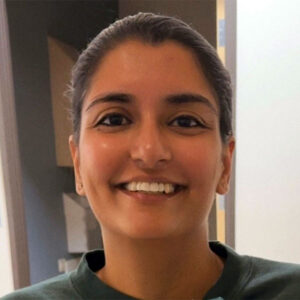
Sridharan earned her MD and PhD at SMPH followed by an internal medicine residency at University of Chicago and two fellowships: cardiovascular disease at Tufts Medical Center in Boston and clinical cardiac electrophysiology at University of California, Los Angeles (UCLA) David Geffen School of Medicine, and UCLA Medical Center. She now practices cardiac electrophysiology at a community hospital in Tucson, Arizona.
In 2025, she established a scholarship at SMPH to help support future students in MSTP. Her father, Sridharan P. Rangarajan, inspired Sridharan to create the scholarship.
“My dad turned 70 last year, and he always encouraged my two sisters and me to pursue our education,” Sridharan said. “We moved to the United States from the city of Chennai in southern India when I was in high school, primarily because my parents wanted the three of us to receive the best education possible.”
Initially intending to name the scholarship after her dad, Sridharan was happier with the eventual choice — the SVAAS Scholarship. In Sanskrit, the word “svaas” means “breath.” Moreover, each letter in the word “SVAAS” serendipitously aligns with the first-name initials of each member of Sridharan’s immediate family.
When they immigrated from India, Sridharan’s parents and sisters settled in Pittsford, New York, a suburb of Rochester. Sridharan earned her bachelor’s degree from the University of Rochester, and she moved to Madison in 2007 upon being accepted into MSTP.
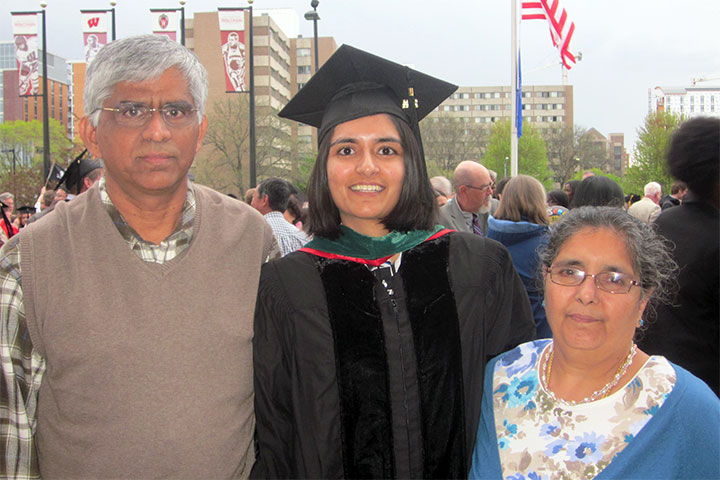
“We were thrilled that Aadhavi decided to come here,” said Anna Huttenlocher, MD, director of MSTP since 2012 and a professor in the Departments of Medical Microbiology and Immunology, and Pediatrics. “We were highly impressed with her undergraduate research, which focused on understanding the cellular and molecular mechanisms of learning and memory using a birdsong model.”
Deane Mosher, MD, professor emeritus of biomolecular chemistry and medicine, who served as MSTP director from 2007 to 2011, could tell immediately upon meeting Sridharan that she was a strong, highly motivated student.
“Aadhavi demonstrated a love for medicine and a passion for research,” Mosher recalled. “We have fond memories of her time at UW–Madison, and I am so proud of what she has accomplished in her medical practice.”
While MSTP is primarily funded by the National Institutes of Health, the program receives some financial support from SMPH and from generous donors such as Sridharan.
The physician-scientists whom we train today will be at the forefront of translating fundamental science into new clinical treatments tomorrow.
- Anna Huttenlocher, MD
“Receiving additional support from an accomplished graduate like Aadhavi makes a huge statement to potential MSTP recruits,” said Huttenlocher. “The physician-scientists whom we train today will be at the forefront of translating fundamental science into new clinical treatments tomorrow. Our graduates are pioneers in cutting-edge science that moves from the bench to the bedside and back. Physician-scientists lead the way when it comes to developing innovative approaches to treating and curing diseases.”
While Sridharan does not miss the cold Wisconsin winters, she has nothing but warm memories of her seven years in Madison.
“I had a great time there and miss the camaraderie from medical school and graduate school,” she said, adding that her parents moved back to India in 2015 to be closer to their own parents, who have since passed. “Madison was the first place I lived away from home, and I loved the energy and compactness of the city. I am still close with people whom I met there and am grateful for these lifelong relationships.”
