Life in the field: Kelsey Schmidt, MD ’17, builds a rural practice

March 30, 2026
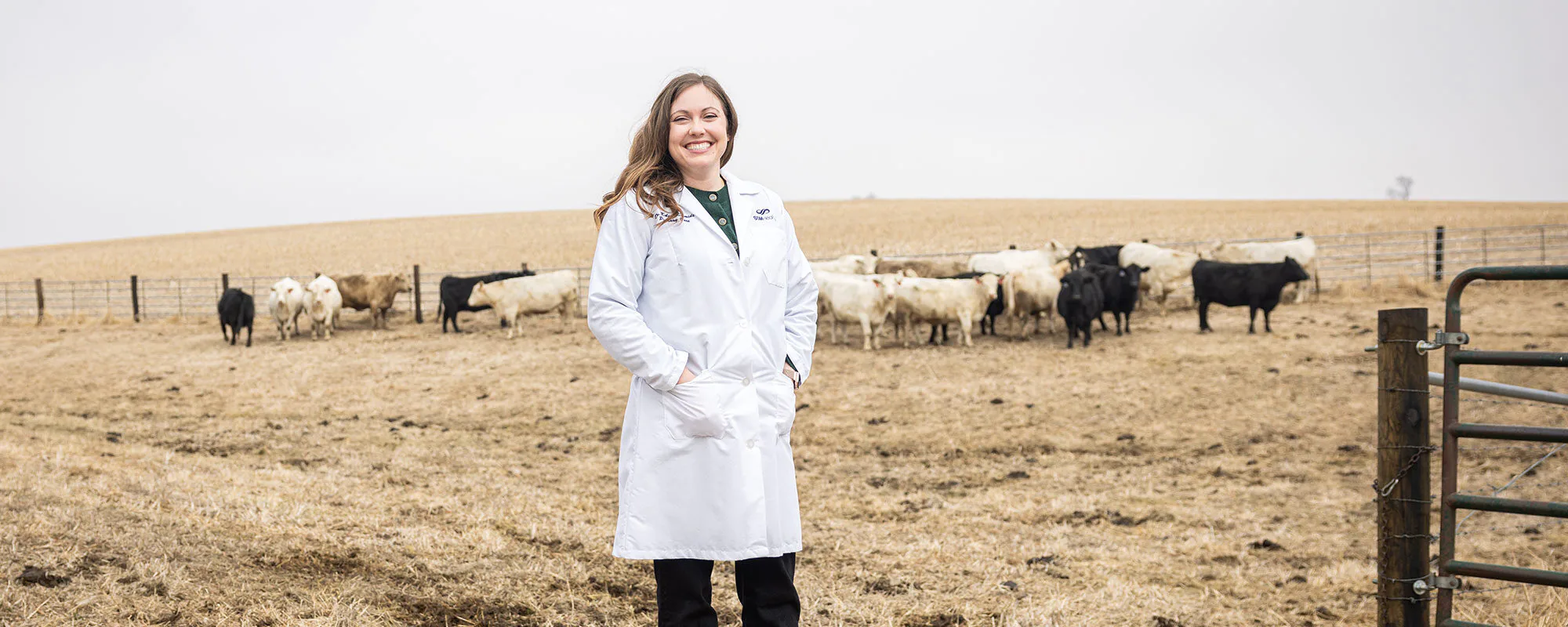
Kelsey Schmidt wearing a doctor's white coat on a farm with cows grazing behind her.
Share

As a family medicine physician in Green County, Wisconsin, Kelsey Schmidt, MD, ’17 treats patients whose paths have intersected with hers over a lifetime. Schmidt grew up in nearby Monroe and returned to the area after completing the Rural Health Equity Track residency program in the UW Department of Family Medicine in 2020.

“The beauty of rural medicine is that you know your patients in a different way,” she said. “I have known some of my patients all my life – one patient told me she’s known me since I was in the womb! I learn so much from them.”

Schmidt’s familiarity with rural life helps her build trust among patients who visit the SSM Health clinics in Brodhead and Albany, where she practices. She treats many farmers, who can be reticent during doctor visits. Schmidt puts them at ease by talking shop.

“I’ll ask them what kind of tractors they have and whether they are green or red — farmers are so attached to their tractors,” said Schmidt, who married her high school sweetheart, beef and crop farmer Tyler Schmidt, BS ’11, in 2013. “I’ll ask if they are a dairy or a beef farmer. I had a farmer who loved to talk with me about the grain bins we were putting up on our farm. All of that helps build rapport.”

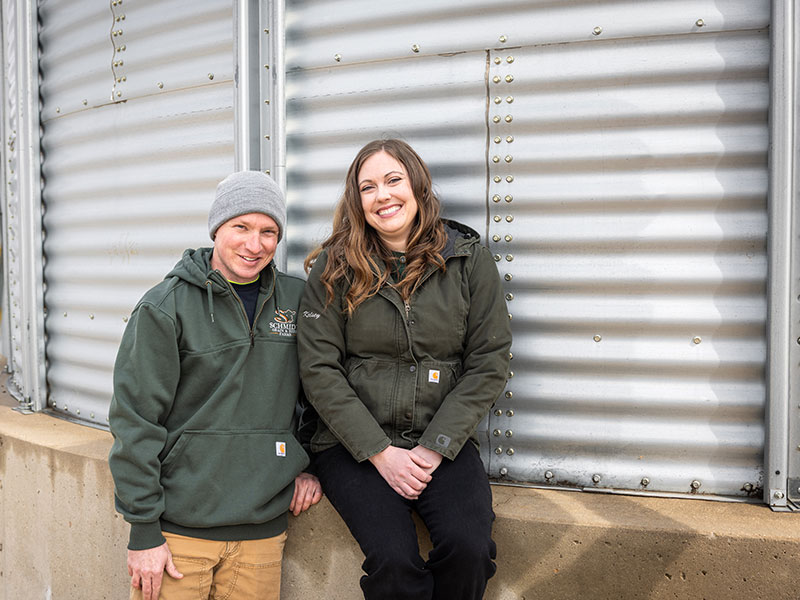
Tyler and Kelsey Schmidt

While Schmidt cares for all family members, she has a special interest in farmers’ health. Along with more common diseases such as diabetes, obesity and hypertension, farmers are vulnerable to occupation-related injuries and illnesses, such as silo-fillers disease, as well as depression. The latter is a growing concern nationwide, with farmers more than two and a half times more likely than members of the general population to die by suicide.

On average, Schmidt sees several farmers a week who are struggling with mental health issues. The signs are subtle and she has learned to watch and listen for cues.

“I might notice that someone seems more reserved or down, or that they have some of the physical symptoms of depression, such as pain and fatigue,” she said. “Sometimes a farmer will come in talking about their mental health, but that is usually only after they have reached a point where a loved one has encouraged them to see a doctor.”

In most cases, a doctor would diagnose depression using the PHQ-9, a standard screening test. But Schmidt has not found that approach as effective with farmers.

“I rarely have a farmer test positive for depression using that test,” she said. “They are not going to come right out and tell you what is going on.”

Instead, Schmidt often starts with a simple question: Do you feel stuck? Farmers often answer ‘yes.’

“It gets them talking,” she said. “Sometimes it takes a follow-up visit to get them to open up more. I tell them that the clinic is a safe place and they can talk to me one-on-one, in privacy. That usually helps soften the reserve.”

Schmidt also tries to normalize the discussion around mental health, letting farmers know that depression and anxiety are common in society and prevalent in farmers. She provides them with a number to call for free teletherapy sessions, an initiative launched by Farm Well, a suicide prevention program for farmers funded by the Wisconsin Partnership Program, a grantmaking program in the UW School of Medicine and Public Health. Sometimes she will prescribe medication.

“Patients are appreciative and thankful when they start feeling better,” she said. “Of course, there are people who don’t get better. Farmer mental health is a difficult issue, and this is a difficult time for many farm workers who don’t have access or don’t feel comfortable coming to my clinic.”

Schmidt earned an undergraduate degree in biomedical engineering from UW–Madison in 2013. She chose her major not only because she thought it would set her up well for medical school but also because it “sounded like fun.”

“I loved to take things apart and put them back together,” she said. “I had an interest in engineering, but I knew from high school on that I wanted to be a doctor and see patients.”

Like any rural family medicine practitioner, Schmidt must think on her feet and deal with unexpected problems. She treats many urgent cases in her clinic with the resources on hand. Often she is the only doctor on staff, and if an emergency arises, Schmidt’s other patients must wait. She recalled a patient who came in with a nearly severed finger.

“In Madison, I would have sent him to a hand clinic,” she said. “I gave him the options and he wanted me to suture it. We did a lot of laceration repair in medical school, so I went back to the basics, and took the time I needed to fix it. Meanwhile, people with appointments are waiting longer in the lobby. But when that happens, people usually understand that there was maybe a friend or neighbor in there who needed more time for care.”

In addition to her physician duties, Schmidt serves on the steering committee for the Rural Health Equity Track in the Department of Family Medicine and is a community preceptor for the department’s SSM Monroe Family Medicine Residency. She also works to promote public health in her community, pointing with pride to her successful advocacy efforts to keep fluoride in Monroe’s drinking water.

The beauty of rural medicine is that you know your patients in a different way. I have known some of my patients all my life.

  • Kelsey Schmidt, MD '17

In addition to farmer health, Schmidt has special interests in breastfeeding medicine — she is a certified lactation consultant — and addiction medicine. She was one of the first medication-assisted treatment physicians in Monroe and has worked to decrease the barriers and stigma around that type of therapy.

Living on a large farm, raising a young family and seeing an average of 80 patients a week, Schmidt laughed when asked if she ever felt overwhelmed.

“Rural family medicine is not for the faint of heart,” she conceded. “But fortunately, not every day is overwhelming. That’s the saving grace.”

That, and the sense that she is providing needed care to individuals who are far from strangers. Early in her practice, a patient presented Schmidt with a Christmas ornament in the shape of an angel.

“She told me the ornament had been given to her by my grandmother, who once worked in my clinic as an accountant,” Schmidt said. “The patient had saved it for more than thirty years, and after my grandmother died, she gave it to me. My grandmother’s handwriting was on it.”