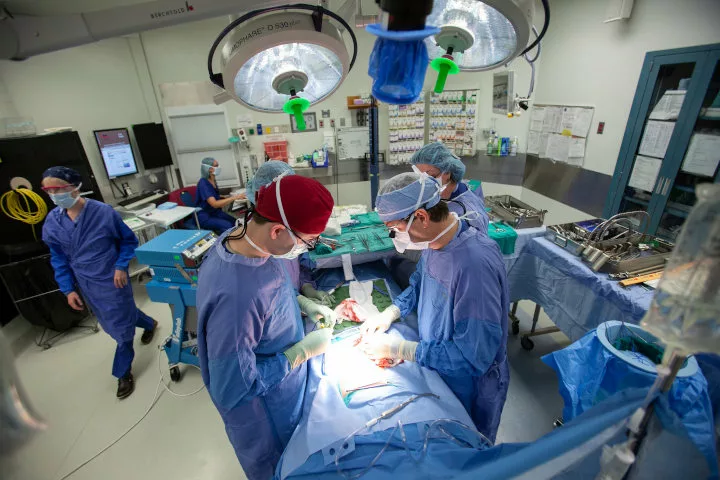
Over the last several years, kidney exchanges have become ever more complex — which is a big win for people who desperately need a healthy kidney. Not only are the chains longer (some of the longest involve more than 30 pairs), but UW Health also has implemented a kidney voucher program. A living donor can donate a kidney on behalf of a specific recipient at a time that is convenient for that person to donate, with the understanding that the recipient will receive a kidney from another living donor when he or she is ready for it — which may be months to years later.
Additionally, living liver donation continues to be a good option for transplant patients who might otherwise have to wait years for a deceased donor organ. After years of success serving living liver donors, UW Health recently started a non-directed living liver donation program, during which people can donate a portion of their livers to be given to recipients on the transplant waiting list.
A Leader in Pediatric Transplantation
For many years, UW Health has treated children who need kidney and liver transplants. Recently, the center began offering pediatric pancreas and lung transplants, and in September 2021, a new pediatric cardiologist will come on board to launch the Pediatric Heart Transplant Program. At that time, University Hospital will become a member of an exclusive group — a comprehensive adult and pediatric center that transplants all solid organs.
World-class Research Center
All the advancements at the SMPH and UW Health are possible only because of arduous research. The UW Health Transplant Center is one of the leading research institutions in the country. Researchers from every transplant program are investigating methods of increasing the donor pool, preserving organs and decreasing the immune response. At any given time, the academic medical center is offering several clinical trials for patients. For example, UW Health was part of a clinical trial that allows patients to substitute belatacept, an anti-rejection drug, for calcineurin inhibitors and the need for chronic use of steroids. One such steroid, prednisone, causes infamous side effects, including weight gain, mood swings and insomnia. Belatacept now is a superior alternative for many patients who want to decrease the number of anti-rejection medications they take.
A Saving Grace for Patients in Pain
In addition to traditional organ transplant, UW Health has become the foremost center in the United States for renal auto transplant. The procedure, which involves removing the patient’s kidney and replacing it lower in that person’s abdomen, is used to treat patients who have chronic flank pain. Many such patients have suffered from unbearable pain for years because of conditions such as nutcracker syndrome, which occurs when an artery in the abdomen squeezes the left renal vein. UW Health experts pioneered the use of renal auto transplant to treat these patients, and it has become the hospital of choice for many people — usually women — who suffer from these debilitating problems.
Future Outlook
The UW Health Transplant Center has been going strong for 55 years, and while it has become renowned for many world-class innovations, physicians and researchers aren’t resting on their laurels. Rather, they’re looking to the future — to the possibility that they can treat more patients, recover more organs, eliminate more complications and save more lives.