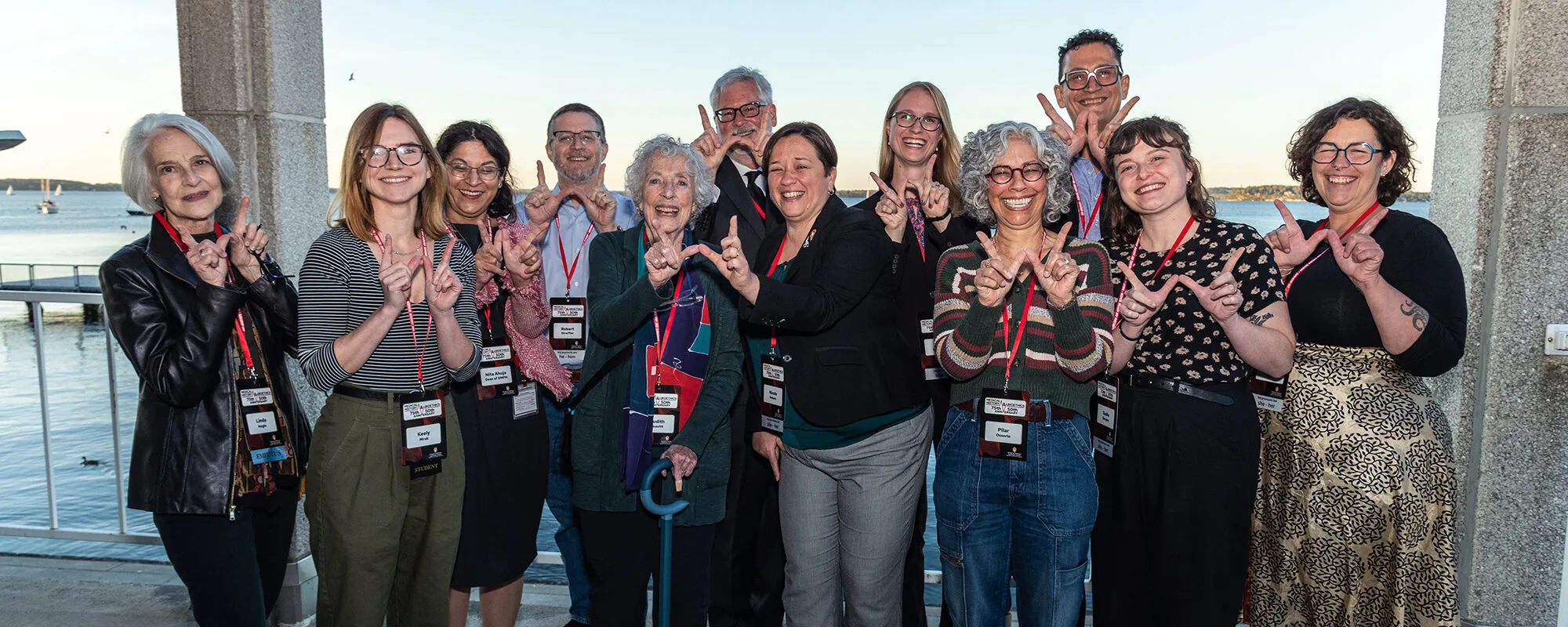
Front row (left to right): Linda Hogle, PhD, Keely Mruk, MA, Nita Ahuja, MD, MBA, Judith W. Leavitt, PhD, Nicole Nelson, PhD, Pilar Ossorio, PhD, JD, Sadie Bergen, PhD, Nicole Senter, MS; back row: Rob Streiffer, PhD, Richard C. Keller, PhD, Dana Landress, PhD, Pablo Gómez, MD, PhD
Share
In October 2025, the University of Wisconsin School of Medicine and Public Health’s Department of Medical History and Bioethics celebrated 75 years as a world leader in the history of medicine and 50 years of excellence in bioethics.
Established in 1950 when Dean William S. Middleton, MD, appointed Erwin H. Ackerknecht, MD, PhD, as chair, the Department of the History of Medicine was the second such department in the United States. In 1973, the department added the world’s first medical school-based bioethics program under the direction of Norman C. Fost, MD, MPH, now a professor emeritus. Since then, the Department of Medical History and Bioethics has been the home of social medicine and medical humanities at UW–Madison, where faculty are committed to advancing the Wisconsin Idea through research excellence, innovative teaching, and extensive service.
“Although there have been many changes in our department’s long history, what remains consistent is our tradition of interdisciplinary collaboration to advance understanding of some of the most important human dimensions of health and health care,” says Richard C. Keller, PhD, professor of medical history and bioethics, who joined the department in 2002 and has served as department chair since 2023.
Anniversary events began at the Pyle Center with a reception and keynote lecture attended by dozens of faculty, students, alumni, and friends of the department. After welcoming remarks by Dean Nita Ahuja, MD, MBA, alumna Leslie Reagan, PhD ’91, professor emerita of history at the University of Illinois Urbana-Champaign, reflected in her address about how her graduate work helped ground her commitment to social justice in a scholarly foundation.
The next day’s program focused on the department’s past, present, and future. Keller shared a historical reflection, noting that Ackerknecht had become a U.S. citizen after being forced into exile from his native Germany due to the rise of the Nazi Party. In Ackerknecht’s first lecture at UW–Madison, Keller recounted, he spoke of disease as at least as much a social phenomenon as a biological one, setting the department’s tone for decades.
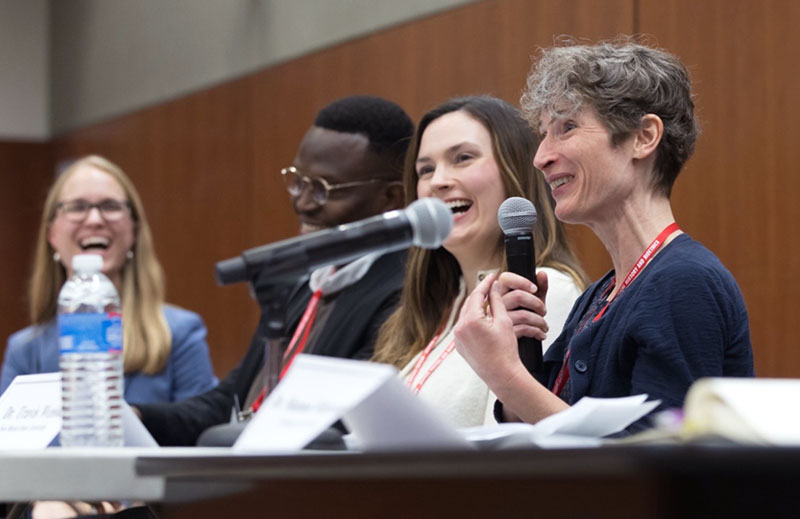
Next, a panel of recent alumni, who serve as faculty and postdoctoral fellows across the United States, described how formative experiences during graduate work in the Department of Medical History and Bioethics prepared them to embrace difficult but important research in reproductive health, weight, nutrition, disabilities, global health, and more.
Additional panels highlighted faculty collaboration across UW–Madison. Nicole C. Nelson, PhD, associate professor, Department of Medical History and Bioethics, discussed the importance of teaching the history of medicine, and Elizabeth Fleming, MD (PG ’14), assistant professor of family medicine and community health, spoke of her work with the Collective for Humanism, Arts, and Storytelling in Medicine, which connects clinicians, scholars, and students who share an interest in the medical humanities. J. Paul Kelleher, PhD, professor of medical history and bioethics, discussed the establishment of the Path of Distinction in Bioethics, and medical students Apoorva Dhawan and Madison Harris described how that path of distinction has enriched their studies.
The concluding panel focused on research. Pablo Gómez, MD, PhD, professor of history and medical history, discussed his new book on the crucial role of medicine in the Atlantic slave trade, and Rob Streiffer, PhD, professor of bioethics and philosophy, described his work on animal research ethics. Gretchen Schwarze, MD, professor of surgery and medical history and bioethics, presented her new research on patient-surgeon conversations and informed consent, while Pilar Ossorio, PhD, JD, professor of law and bioethics, shed light on her work on human subjects research. The day concluded with an open house hosted by Ebling Library’s Special Collections Department; participants viewed an exhibit about the history of medicine.
It was heartwarming to reconnect as our alumni and colleagues shared their fascinating work into the human dimensions of medicine and health.
Richard C. Keller, PhD, professor of medical history and bioethics, department chair
Throughout the Department of Medical History and Bioethics’ rich history, its faculty have served in executive roles in professional societies, participated on and chaired state and federal advisory committees, and received national and international honors, including from the National Academy of Medicine.
“The 75/50 celebration provided a remarkable opportunity to reflect on our history and to imagine our future,” Keller notes. “It was heartwarming to reconnect as our alumni and colleagues shared their fascinating work into the human dimensions of medicine and health.”
From a one-person entity in 1950, Keller adds, the department has become a vibrant and interdisciplinary space for enhancing the understanding of medicine and health as extraordinary sources of human meaning.
Department History
1909: William Snow Miller, MD, organizes a Medical History Seminar for UW–Madison.
1950: Dean William S. Middleton, MD, creates the Department of the History of Medicine, appointing Erwin H. Ackerknecht, MD, PhD, as chair.
1965: Nicholas Mani, MD, becomes chair.
1971: Guenter B. Risse, MD, PhD, becomes chair.
1972: Maurice L. Richardson Fellowship in the History of Medicine is established.
1973: Norman C. Fost, MD, MPH, establishes the Program in Medical Ethics, the world’s first bioethics program in a medical school.
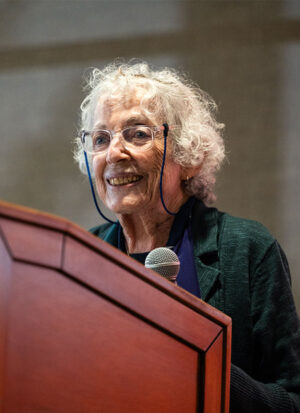
Judith W. Leavitt, PhD
1975: Judith W. Leavitt, PhD, becomes the department’s first woman faculty member.
1977: Ronald L. Numbers, PhD, becomes chair.
1981: Leavitt becomes chair.
1989: Vanessa N. Gamble, MD, PhD, becomes the department’s first Black faculty member.
1993: Harold J. Cook, PhD, becomes chair.
2000: The department celebrates its 50th anniversary.
2002: Department renamed to Medical History and Bioethics.
2003: Warwick Anderson, MD, PhD, becomes chair.
2008: Susan Lederer, PhD ’87, becomes chair.
2009: The first-annual Bioethics Symposium takes place.
2020: At the height of the COVID-19 pandemic, Fost and Karola Kreitmair, PhD, serve on a state committee to establish a ventilator allocation policy.
2022: The Path of Distinction in Bioethics (PoD-B) is established by Kreitmair and J. Paul Kelleher, PhD.
2023: Richard C. Keller, PhD, becomes chair; PoD-B graduates its first student.
2024: Nicole C. Nelson, PhD, co-founds CHASM, the Collective for Humanism, Arts, and Storytelling in Medicine.
2025: The department celebrates its 75th anniversary, as well as the 50th anniversary of the Program in Medical Ethics.