Federal SPORE Grants Bolster Cancer Research

Highly Competitive Funding Fuels Work on Prostate Cancer and Head and Neck Cancers
December 16, 2025
VOL 27 NO 3
Share

The University of Wisconsin Carbone Cancer Center seldom takes a back seat to other institutions when it comes to producing transformative research breakthroughs. Designated in 1973 by the National Cancer Institute (NCI) as one of the nation’s original comprehensive cancer centers — and still the only one in Wisconsin — UW Carbone remains an unwavering reservoir of highly collaborative, cutting-edge researchers across the UW–Madison campus.

This preeminence played a significant role when the NCI awarded UW Carbone two prestigious Specialized Programs of Research Excellence (SPORE) grants in 2016 and 2023. Since established in 1992, SPOREs have served as the NCI’s premier translational research program, significantly boosting the impact of bench-to-bedside cancer research at select U.S. cancer centers.

“Receiving a SPORE grant, let alone two, is a real feather in the cap for an organization like ours,” says Christian Capitini, MD, acting director, UW Carbone. “The NCI awards these grants to just a handful of centers with highly reputed researchers from basic science to clinical care. In addition to funding research, the grants help us train the next generation of cancer researchers. Having two SPOREs is a great recruitment tool for prospective faculty.”

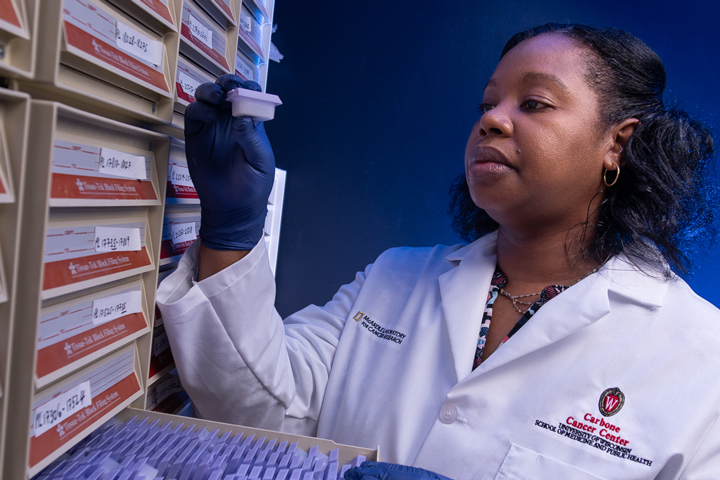
Ella Ward-Shaw holding a tissue sample.
In a histology suite related to the Head and Neck Cancer Specialized Program of Research Excellence grant, research specialist Ella Ward-Shaw retrieves a paraffin-embedded block of tissue for sectioning.

Jacques Nor, DDS, PhD, external advisor for UW Carbone’s head and neck cancer SPORE and dean of the School of Dentistry at the University of Michigan, adds, “A SPORE grant is a very prestigious recognition of the quality of the investigators and the environment in which they work.”

UW Carbone’s first SPORE grant was awarded for head and neck cancer; it was successfully renewed for a second five-year term in 2022. Then, in 2023, the center received a second SPORE grant, with this one aimed at prostate cancer. Each five-year cycle for original grants or renewals provides approximately $11.5 million plus matching funds provided by UW Carbone, the UW School of Medicine and Public Health (SMPH), the UW–Madison Graduate School, and several departments.

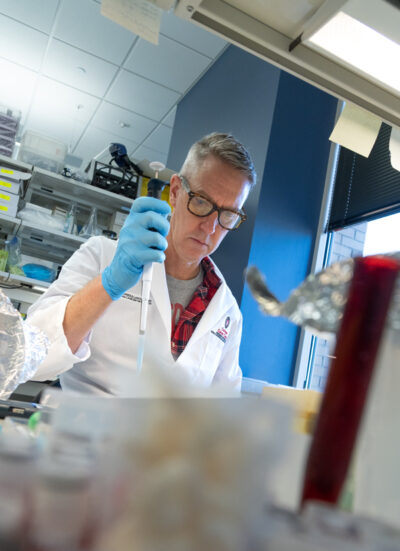
Denis Lee holding a pipette.
Denis Lee, a researcher in the Lambert laboratory in the Wisconsin Institutes for Medical Research, conducts an assay related to the Head and Neck Cancer Specialized Program of Research Excellence grant.

David Jarrard, MD, a professor in the Department of Urology and leader of the urologic oncology team at SMPH, notes that UW–Madison’s long history of high-caliber, multidisciplinary, translational research boosted the chances of success when UW Carbone faculty and staff submitted SPORE applications.

“This grant allows us to amplify our bench-to-bedside efforts,” says Jarrard, principal investigator (PI) of the prostate cancer SPORE grant.

Paul Harari, MD, professor and former chair of the Department of Human Oncology and PI of the head and neck cancer SPORE, says much needs to be done to make cancer more curable and its treatments more comfortable for patients.

“Over my 35 years as a radiation oncologist at UW–Madison, we have come a long way,” Harari observes. “Yet, today’s worldwide cure rate for head and neck cancers remains 50 to 55 percent. We need to push that higher. We also need to make treatments even more precise and tolerable to reduce unpleasant side effects, such as dry mouth and throat or swallowing problems. Ideally, future patients will be cured with a higher quality of life.”

Thanks in part to the research being funded by our SPORE grant, we see incredible promise for increasing the cure rate for men with prostate cancer.

  • David Jarrard, MD

UW Carbone’s prostate SPORE grant focuses on metastatic disease, for which cure rates are far lower than for a locally confined disease.

“If you look across the country, Wisconsin has the 8th or 9th highest rate of prostate cancer mortality,” says Jarrard. “Thanks in part to the research being funded by our SPORE grant, we see incredible promise for increasing the cure rate for men with prostate cancer.”

Douglas McNeel, MD, PhD (left) and David Jarrard, MD
Paul F. Lambert, PhD ’85 (left) and Paul Harari, MD

Head and Neck SPORE Grant

Harari and Paul F. Lambert, PhD ’85 (basic science co-leader), direct the head and neck SPORE grant. Lambert is the director of McArdle Laboratory for Cancer Research and chair of the Department of Oncology. Approximately 35 faculty members and 120 staff members are involved in the head and neck SPORE grant, which includes these scientific projects:

Project 1: Targeted Radionuclide Therapy

Leaders: Zach Morris, MD, PhD (PG ’16); Jamey Weichert, PhD; Paul Harari, MD

Researchers are testing a targeted form of radiation therapy (NM600) that, ideally, will result in greater patient survival. The project combines the most common form of immunotherapy with NM600, which is given via injection. One of the excellent features of this type of radionuclides is they can be given diagnostically and therapeutically, meaning they can both image and treat tumors.

“We call it a theranostic agent,” Morris says. “With the help of PET [positron emission tomography] scans, we first determine whether the patient’s tumor will absorb the agent before we inject a therapeutic dose. This process lets us create a personalized prescription to deliver the desired amount of radiation for each patient.”

Project 2: Biomarker Prediction of Treatment Outcomes

Leaders: David Beebe, PhD ’94; Paul Harari, MD

Health care professionals need better tools to predict whether a treatment will increase survival for head and neck cancer patients. This project advances a powerful, patient-specific bioengineered model — developed at UW–Madison — built from individual patient tumor cells to predict tumor response and investigate biomarkers of response in tumor tissue. A clinical study will be performed to test the feasibility of using response data from the model to guide head and neck cancer treatments for individual patients based on specific tumor characteristics. This project combines patient-specific data, such as single-cell RNA sequencing, to identify patterns that predict how well treatments work. The result will improve decision‑making.

Project 3: Protein-Blocker to Enhance the Body’s Immune System

Leaders: Deric Wheeler, PhD ’04; Justine Yang Bruce, MD

Researchers hope to show that a new drug can block the unwanted impact of two proteins found on tumor cells — Axl and MerTK. When these proteins work in tandem, they prevent the immune system from fighting cancer in patients who have been given immunotherapy. Mouse model research demonstrates that reprogramming the microenvironment that feeds a tumor in a way that reignites the immune system results in a more powerful anti-cancer response. If similar results are found in humans, immunotherapy could more effectively treat patients with specific head and neck cancers.

Prostate SPORE Grant

Jarrard and Douglas McNeel, MD, PhD (co-PI), professor, Department of Medicine, and genitourinary oncologist, UW Health, are overseeing UW Carbone’s prostate SPORE work, in which more than 50 faculty and staff members are contributing. This grant is supporting numerous developmental ideas and three main research projects:

Project 1: Enhancing Understanding of How Prostate Cancer Spreads

Leaders: Joshua Lang, MD (PG ’08, ’11); Sheena Kerr, PhD; Melissa Skala, PhD; David Jarrard, MD

Researchers know that prostate cancer cells do not act alone; they can “trick” nearby cells in the microenvironment that helps feed the cancer. This makes blood and lymph vessels “leakier,” giving cancer cells a new pathway to the rest of the body. This project recreates a patient’s tumor and its microenvironment on a chip, allowing researchers to examine how genetic and cellular changes cause the cancer to spread. A better understanding of which cancers are most lethal would position researchers to test treatments that could prevent metastasis.

“There are many new therapies being developed that target these other cell types in the tumor environment. We are studying how and for whom these therapies will be most effective,” says Lang.

Project 2: An Anti-cancer Vaccine to Prevent Metastasis in High-Risk Patients

Leaders: Douglas McNeel, MD, PhD; Christos Kyriakopoulos, MD; David Jarrard, MD

For more than 20 years, UW–Madison researchers have been working to develop a DNA vaccine that, when given in conjunction with testosterone-reducing hormone therapy and immunotherapy, makes cancer cells more “visible” to the body’s immune system. Because hormone therapy causes cancer cells to over-express their androgen-receptor protein, the vaccine appears to more easily recognize that protein, signaling the immunotherapy treatment to kill more cancer cells. Early clinical trials have shown that high-risk patients who received the vaccine are living longer than unvaccinated individuals; however large-scale, Phase III trials are still to come.

“If we can clearly demonstrate that our vaccine is triggering cancer-destroying, tumor-specific immune responses, we could see transformative increases in survival times,” says McNeel.

One of the prostate SPORE team’s external advisors, Howard Soule, PhD, executive vice president and chief science officer of the Prostate Cancer Foundation, says this vaccine project could be a tremendous breakthrough.

“Having a project included in the SPORE grant typically means that the NCI thinks you are on to something,” says Soule. “Other cancer vaccines have been tried, but what makes this unique is that it is targeted to the central activity that leads to progression and death. Once tested on a larger scale, this vaccine could be off to the races.”

Project 3: Using Lesion-Response Technology to Treat Patients with Greater Precision

Leaders: Glenn Liu, MD (PG ’00, ’02); Robert Jeraj, PhD; John Floberg, MD ’14, MS ’10, PhD ’12

This project seeks to extend survival time for patients with advanced prostate cancer — namely cancer that has already spread elsewhere and no longer responds to testosterone-reducing hormone therapy. UW–Madison researchers believe that even though these patients’ conditions are not curable, conventional clinical decision-making is too dichotomic; the patient is classified as either “responding” or “progressing.”

By examining how each lesion — not just a subset — responds to treatment, physicians can make decisions about care that improve patient outcomes.

“Our work shows that patient outcome is driven by resistant lesions,” Liu says. “Identifying and targeting that resistance with lesion-tracking software can improve patient care by optimizing benefit from existing therapy options.”

A Patient’s Perspective

SPORE-recipient institutions must include patient advocates on their teams. In this capacity, Marshall Flax is among those who advise the head and neck SPORE team; others similarly advise the prostate SPORE team.

When he was diagnosed with stage 4 tonsil cancer in 2003, Flax was treated with radiation and chemotherapy that saved his life but left him susceptible to swallowing problems. He says having patient advocates on SPORE teams helps remind researchers that their work has a real-world impact on people’s lives.

“When they start talking about something like dry mouth, that is when we pipe up and keep them focused on the side effects that may come with life-saving treatment. It is wonderful to know that this research may help future patients avoid things like dry mouth or swallowing difficulties.”

It is fulfilling to see everyone come together and build something greater than the sum of the parts.

  • Christian Capitini, MD

Future Outlook

Especially striking to those involved in the SPORE grants at UW–Madison is the highly collaborative research culture that permeates the campus.

“We have a unique ecosystem here that is excellent for our SPORE researchers,” says Capitini. “We can leverage resources across the campus — from basic sciences to biomedical engineering, and from medical physics to medical and radiation oncology. It is fulfilling to see everyone come together and build something greater than the sum of the parts.”


Running Like Clockwork

by Kris Whitman

Stately clocks stand the test of time. Often revered by members of a community, many such clocks include actions beyond timekeeping, such as marking the lunar cycle and chiming to alert people at pre-set intervals.

Some such tasks — tracking months, quarters, and years, and communicating about milestones — are among the responsibilities of administrators who are integral to two National Cancer Institute-funded Specialized Programs of Research Excellence (SPORE) grants at the University of Wisconsin Carbone Cancer Center (see main article). For the head and neck cancer SPORE grant, Shari Piaskowski, BS, is the administrator; and for the prostate cancer SPORE grant, Lauren Weeth-Feinstein, MPH ’13, and Renee Zook, MBA, share that responsibility along with other work at the center.

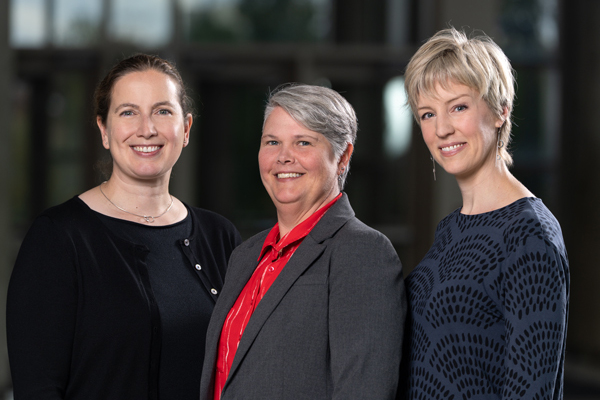
Left to right: Shari Piaskowski, BS, Renee Zook, MBA, Lauren Weeth-Feinstein, MPH ’13

According to Paul Harari, MD, a professor of human oncology and the principal investigator of the head and neck SPORE, “These behind-the-scenes team members keep the projects running like clockwork.” Noting that the grants involve large numbers of people across many departments, he says the administrators “keep us all moving in the same direction using magic touches.”

Piaskowski, Zook, and Weeth-Feinstein say they take a high-level view to gather and share background materials, coordinate small and large meetings, and track deliverables to stay on top of the many milestones in each five-year grant cycle.

Each grant administrator gained research experience through their education and prior work. All say they are grateful for the dedication and time commitment of the principal investigators, project leaders, and other faculty and staff members.

“Everyone cares deeply about the research missions,” says Zook. “I don’t think you can find a person who has not been affected in some way by cancer.”

Piaskowski adds that active involvement of patient advocates, as required for SPORE grants, serves as a reminder to the team of the ultimate goal of each SPORE to improve options and quality of life for patients with cancer. About the advocates for the head and neck SPORE, she shares, “Hearing our head and neck cancer patient advocates’ voices still greatly impacted by their treatment delivered years ago keeps us grounded to our mission.”

Despite the dry mouth and other lasting side effects of their treatment, these patient advocates are eager to bring positive and inspiring energy to SPORE meetings and community events.

It is beautiful how their expertise from various areas comes together and moves our strategic goals forward toward finding a cure for cancer.

  • Renee Zook, MBA

The programs’ interdisciplinary nature appeals to Weeth-Feinstein; she says, “I love being able to interact with and learn from experts in so many disciplines. I like seeing them make connections that bring new approaches to bear on research problems.”

In agreement, Zook comments, “It is beautiful how their expertise from various areas comes together and moves our strategic goals forward toward finding a cure for cancer.”

Tags