For decades, the University of Wisconsin School of Medicine and Public Health (SMPH) has been a powerhouse of biomedical innovation, producing patents, licensing deals, and startup partnerships that shape patient care. Ideas born in labs and clinics become real-world solutions that improve lives.
“The school stands out because its faculty members’ innovations are directly tied to the teaching hospital and focused on advancing patient care,” says Jeanine Burmania, senior director of intellectual property and licensing, Wisconsin Alumni Research Foundation (WARF). “We see transformative innovations, including new treatments and new ways of delivering treatment to a broader population.”
Because SMPH clinical faculty members treat patients and many conduct research, the innovations they bring to WARF are often focused on solutions to observed gaps in care.
“Clinicians who have done a procedure a thousand times are uniquely positioned to make enhancements. They develop modifications to devices or refine software protocols to add functionality or shorten procedure times,” Burmania says.
The journey to bringing academic research into the hospital or clinic can be long and difficult, requiring years of safety testing, regulatory approvals, and significant financial investments.
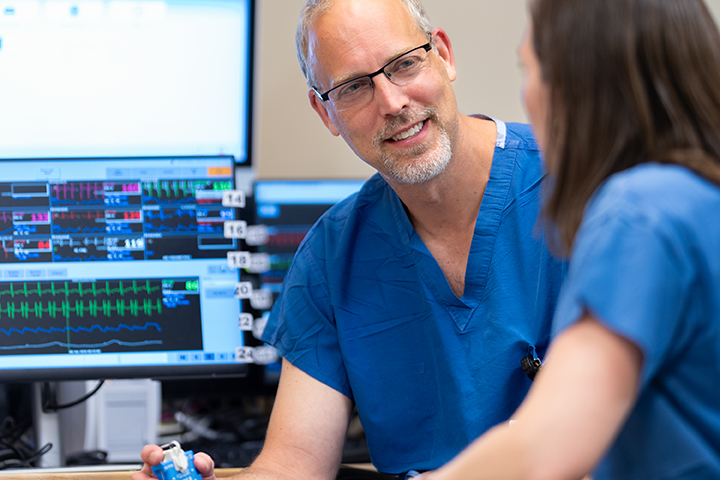
Nicholas Von Bergen, MD (left), and Jenna Torgeson, NP, a lead patient educator in the Department of Pediatrics, discuss the AtriAmp device that Von Bergen and colleagues developed, patented, and brought to market; the device provides a continuous heart rhythm display in postoperative patients, something previous monitors do not provide.
Post-Surgical Monitoring
As an example, Nicholas Von Bergen, MD, is a pediatric electrophysiologist who monitors young patients, including newborns, after major heart surgery. Up to 60 percent of pediatric patients experience arrhythmias after heart surgery, but diagnosing and treating them can be challenging because traditional bedside monitors do not provide enough visual information to consistently detect a problem. A professor in the Department of Pediatrics, Von Bergen was determined to create a device to display a continuous heart rhythm in postoperative patients.
“I was very frustrated because we had inadequate information for an accurate rhythm diagnosis in our sickest patients. So, I invented the AtriAmp,” shares Von Bergen.
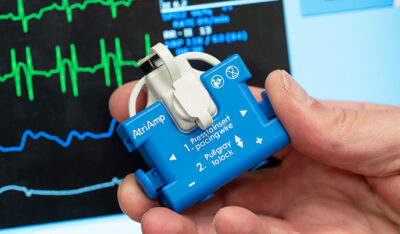
The AtriAmp device is placed on the patient’s chest after surgery, receiving atrial signals from temporary pacing wires implanted during surgery. It connects to the bedside monitor to provide a high-quality, real-time, atrial electrogram, which gives clinicians more information and could result in better outcomes.
“The device is straightforward to use, with safety mechanisms in place,” Von Bergen says.
AtriAmp device
Starting in 2017, he worked with five UW–Madison biomedical engineering students to develop the AtriAmp prototype.
“I moved forward because I knew the device would create an improvement in patients’ care, and I was willing to risk time and money to achieve that,” he explains.
In 2018, working with senior design students, Von Bergen founded Atrility Medical to develop the device, and he filed patents with WARF that WARF, in turn, licensed to the company.
“It was easy to see where the company could provide solutions for patients and grow a pipeline of products for post-surgical cardiac monitoring,” says Burmania.
Around this time, Atrility Medical also started working with the Isthmus Project, led by Elizabeth Hagerman, PhD, chief innovation officer, UW Health. The organization’s innovation hub provides commercialization support and early-stage investments for SMPH faculty members and UW Health clinicians with new health care technologies.
“Dr. Hagerman shared her expertise, facilitated well-defined steps to commercialization, and assisted with connections at UW–Madison to help evaluate research avenues,” recalls Von Bergen.
Involving students in creating technology teaches them how to be innovative and translate their ideas into commercial products
Jeanine Burmania
Two students who had helped develop the AtriAmp prototype, Matt Knoespel and Phil Terrien, now serve as vice presidents for Atrility Medical.
“Involving students in creating technology teaches them how to be innovative and translate their ideas into commercial products,” says Burmania.
WARF Ventures, Isthmus Project, and Rock River VC made small, early-stage investments to help Atrility Medical earn U.S. Food and Drug Administration (FDA) approval, test the product’s fit in the pediatric market, and begin assessing the adult market.
Over four years, AtriAmp has become the standard of care at UW Health and elsewhere for pediatrics. Atrility Medical and the early investors are preparing for a Series A round of financing, anticipating growth into the adult market.
“AtriAmp is used in about 30 percent of children’s hospitals nationwide, especially for the highest-risk patients,” says Von Bergen.
Noting that Atrility is poised to enter the realm of software based on interest from health care centers, Von Bergen says, “The company could go in several incredible directions with software: rhythm assessment, predictive modeling, or hemodynamic assessment. We have access to a high-quality signal and data, which could provide unique insights into postoperative heart rhythm monitoring. We are at the cutting edge of innovation, as we can analyze data, program faster, and understand in depth — with machine learning and artificial intelligence (AI) — things the eye might not see but that continual monitoring can find. We are looking to bring the experience of the electrophysiologist to every bedside, while making predictions about future events and potential outcomes of interventions.”
WARF Ventures CEO Michael Partsch, MBA, is enthusiastic about the opportunity to bring Atrility Medical into the data arena.
“With its device, Atrility is unlocking data that turns a bedside monitor into a real-time EKG,” Partsch says. “We are looking at raising capital around the evolution of the company in the AI space. Atrility can develop algorithms that could detect arrhythmias and alert clinicians before a condition endangers a patient.”
Surgical Markers
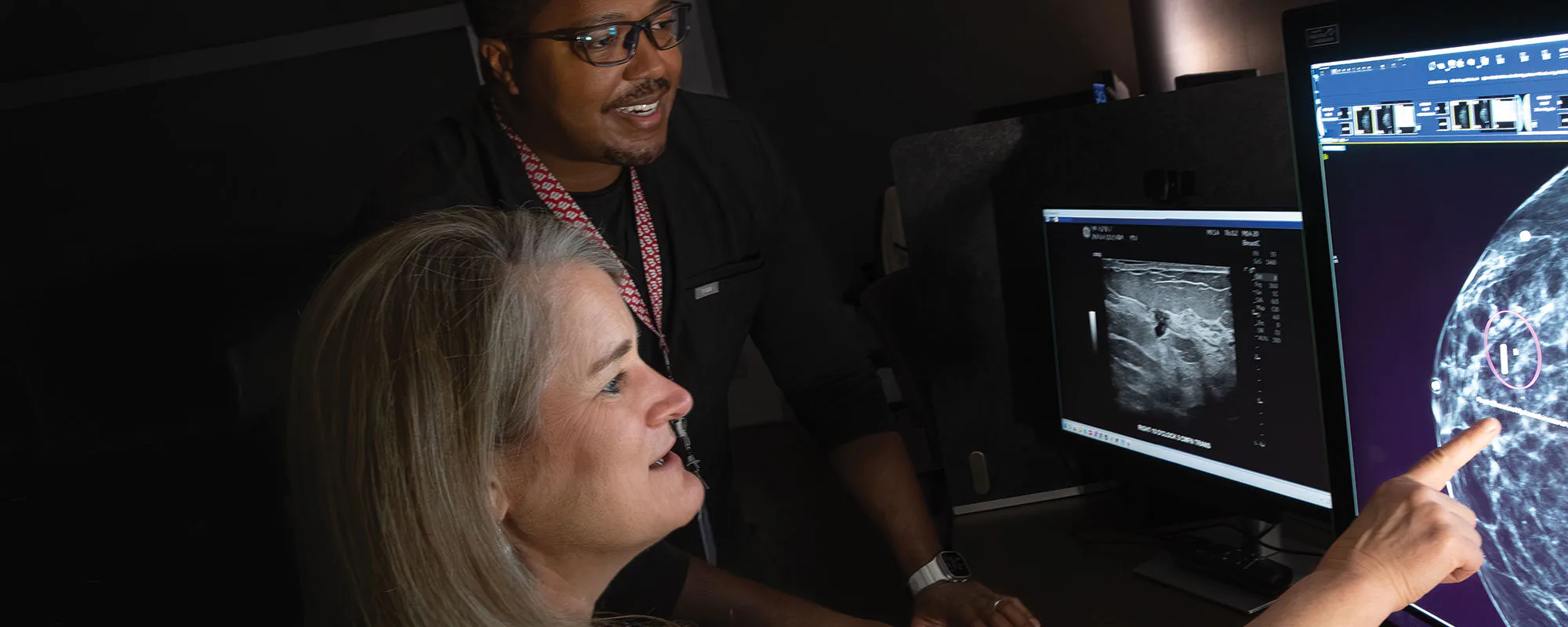
Technology developed by SMPH Professor of Surgery Lee Wilke, MD — to replace legacy markers in tumor surgeries — is another example of a patent that addresses a medical challenge.
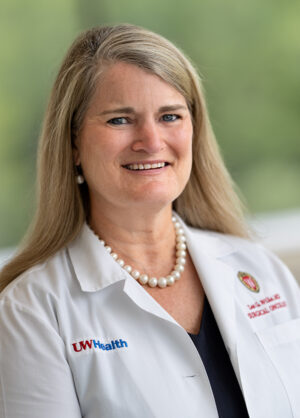
Lee Wilke, MD
For 75 years, doctors performing breast biopsies have marked the mass or tumor with a small metal clip. If a patient then needed a lumpectomy surgery, a radiologist would insert a wire through the skin to the biopsy clip, providing a trail to the lesion. The surgeon’s incision would usually follow the trail to remove the wire and lesion. Wilke, the senior medical director of clinical cancer services at UW Health Carbone Cancer Center — who regularly performs this procedure — was determined to develop a less invasive, more precise solution that would be less stressful for patients.
She teamed up with Fred Lee, Jr., MD, professor of radiology; Daniel van der Weide, PhD, professor of electrical and computer engineering; and Laura King to form Elucent Medical and bring to market a new platform for localization of tumors.
“In the development process, the team was thoughtful about including a broad group of stakeholders, including radiologists, operating room technicians, and nurses, to talk about how this would integrate with standard workflows,” says Wilke.
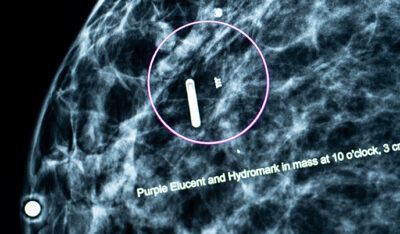
Elucent’s technology replaces the legacy metal clip with a SmartClip that emits a unique signal and can be placed anytime before surgery. The SmartClip system provides a precise location, allowing the surgeon to more accurately plan the incision and remove the correct margin of tissue surrounding the tumor. It was approved by the FDA in 2018, and the related EnVisio Surgical Navigation System and Navigator were approved in 2019.
“The technology allows the doctor, without taking their eyes off the surgical field, to see where they are working in relation to the [SmartClip] target in 3D on the screen,” says Partsch. “It is very precise. They also have the option to view a bigger screen with more detailed topography.”
The device has been used in more than 40,000 breast procedures since 2019, including at top centers around the nation.
“I use my device weekly in surgery and love the ease of use,” says Wilke. “At a recent American Society of Breast Surgeons meeting, it was fun to overhear my surgical colleagues saying they enjoy using it, too. I am very proud of what we developed.”
“We are now able to apply this technology to other cancers and in more hospitals,” Wilke says, adding that the SmartClip is being used by a UW Health neurosurgeon and by surgeons conducting lymph node surgery. Elucent recently received an FDA Breakthrough designation, which will enable lung cancer localization in 2027.
“As physicians, it is always good to talk to people outside our field of expertise, like business experts and engineers, to understand how to bring ideas that help improve patient care to market around the country,” says Wilke, who holds five patents.
Celebrating Innovation
Partsch, Burmania, Hagerman, and others are excited about innovations at the UW School of Medicine and Public Health that positively impact patients.
About Elucent, in which WARF Ventures plans to continue investing, Partsch says, “They did $17 million in sales last year and are looking to grow significantly.”
Isthmus Project has continued to work directly with Atrility Medical as the company further develops the AtriAmp product.
A SmartClip marking a mass
“Seeing these journeys is impressive. It shows that we have all the pieces in place at UW–Madison to take ideas from bench to bedside,” observes Hagerman.
Burmania says, “Large companies do not invest in ideas at the developmental stage, so it is critical that entrepreneurs validate their understanding of what these products can do for patient care. When they put in the effort, there is an opportunity for big medical device companies to buy them and widely distribute their technology.”
Sharing this vision, Partsch adds, “Technology with that higher purpose — helping people live longer, healthier lives — is vitally important. I am excited about bringing these technologies to market.”
Keep the UW School of Medicine and Public Health moving forward by supporting the Strategic Priorities Fund.