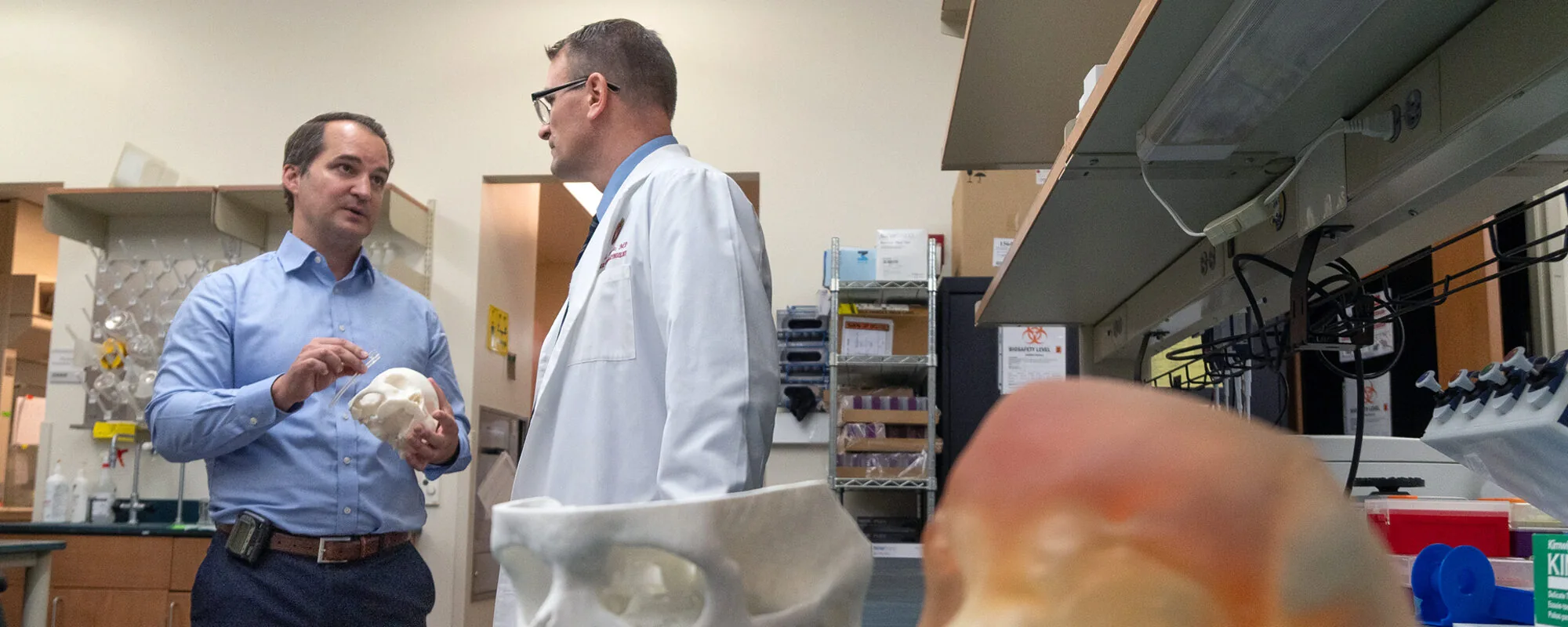
David Zopf, MD, MS, and Tony Kille, MD ’01, discuss a research project.
Share
Upon bringing a newborn home, new parents often are bombarded with advice and counseled to “sleep when the baby sleeps.” However, that advice can go out the window if an infant develops sleep apnea, a condition that disrupts rest not only for the infant but for the entire household.
“When the baby is not sleeping, nobody is sleeping, and that anxiety affects the whole family,” says David Zopf, MD, MS, associate professor and chief of the division of pediatric otolaryngology, Department of Otolaryngology–Head and Neck Surgery, University of Wisconsin School of Medicine and Public Health (SMPH). “Parents have told us they were checking on their child every 30 minutes throughout the night to make sure they were still breathing.”
While sleep apnea is often associated with adults, it affects an estimated 5 to 8 percent of otherwise healthy children, and the prevalence is even higher among children with complex medical conditions such as cerebral palsy, Down syndrome, and craniofacial abnormalities.
David Zopf, MD, MS (left), consults with Lennon Rodgers, PhD, MS, director of the Grainger Engineering Design Innovation Lab at UW–Madison.
“Sleep apnea in children is incredibly common, and yet it is often overlooked,” says Zopf. “In healthy kids, the condition is usually caused by enlarged tonsils and adenoids, and removal of these structures can help. But in children with neuromuscular or genetic conditions, the airway itself may be structurally weak or compromised, so traditional approaches do not work as well.”
Consequences can be profound. Interrupted sleep affects not only a child’s mood, behavior, and academic performance, but also their cardiovascular health, growth, and brain development. It is imperative to find a solution for the child’s health and for the ripple effects throughout the family.
Improving care for pediatric sleep apnea is one component in the growth and evolution of the otolaryngology program. On July 1, 2025, the school officially launched the Department of Otolaryngology–Head and Neck Surgery, marking the culmination of nearly a century of innovation and excellence. Formerly a division within the Department of Surgery, the new department is the school’s 28th, reflecting its national reputation for cutting-edge clinical care; world-class, pioneering research; and exceptional training in ear, nose, and throat (ENT) medicine.
Led by Sandra Lin, MD, professor and chair of the Department of Otolaryngology–Head and Neck Surgery and former chief of the division, the department brings together 30 faculty members across subspecialties, including facial plastic surgery, head and neck oncology, laryngology, otology, neurotology, pediatric ENT, and rhinology. The department’s structure fosters collaboration across these specialties, recognizing that disorders of the ears, nose, throat, head, and neck often are deeply interconnected.
“Department status gives us a stronger voice than before and a seat at the table,” observes Tony Kille, MD ’01, associate professor, Department of Otolaryngology–Head and Neck Surgery. “It allows us to showcase our accomplishments, attract top-tier talent, and expand our programs to meet the growing needs of our patients.”
In December 2024, SMPH and UW Health made history when Kille performed Wisconsin’s first pediatric hypoglossal nerve stimulator implant using a device that stimulates the tongue muscle to prevent airway collapse during sleep. The patient, a teenager with Down syndrome and severe sleep apnea, had undergone multiple surgeries without success.
“This was a game-changer for this teen,” says Kille, adding that repeated sleep studies on the patient indicate significant improvement. “We are now preparing for additional implants and working toward establishing a dedicated clinic for complex pediatric sleep apnea.”
Kille, who has a special interest in airway disorders and emphasizes the importance of team-based care, explains, “These conditions are multifactorial. We work closely with pediatric sleep medicine specialists, pulmonologists, orthodontists, and primary care and developmental pediatricians, as well as others, to get a full picture of the patient’s needs and develop the most appropriate treatment plan.”
Kille adds that the skill and expertise of anesthesiologists, surgical technologists, respiratory therapists, and perioperative nursing teams are vital to assure safe, successful upper airway surgeries for high-risk patients with complex conditions.
For him, the moments of greatest reward often come from the simplest procedures.
“Even something like a tonsillectomy can be life-changing,” says Kille. “When a child starts sleeping better, their mood, behavior, and learning improve. I have had parents tell me their child is ‘a brand-new kid.’ That is incredibly fulfilling.”
He also sees his role as helping to ease parental anxiety.
“We all worry about our kids — it’s our job. But when a child is sick, that worry becomes overwhelming. Even if we cannot promise a perfect outcome, having a plan and showing families that we care can make a huge difference,” notes Kille.
With similar goals and calling on his vast experience, Zopf developed a nasopharyngeal/oropharyngeal stent, a soft, flexible device that helps keep the airway open in children with cerebral palsy and similar, complex conditions. The device, currently in the final year of an approximately $4 million, National Institutes of Health-funded clinical trial, already has been used for more than 30 children and is showing transformative results.
“This device is helping many children avoid a tracheostomy, which is a major surgery with lifelong implications,” says Zopf. “The new approach is simple, non-surgical, and well-tolerated, and it could be transformative for how we care for children with complex, hypotonic airway conditions in patients with cerebral palsy and Down syndrome.”
The device-related clinical trial will likely expand into a multisite study involving SMPH and UW Health, the University of Michigan, Texas Children’s, and Colorado Children’s Hospital. Meanwhile, UW Health is preparing to launch a multidisciplinary, complex Pediatric Sleep Apnea Clinic, bringing together experts in ENT, sleep medicine, pulmonology, and other specialties in the Department of Otolaryngology–Head and Neck Surgery and Department of Pediatrics to provide coordinated, comprehensive patient care.
Lin notes, “It is very important to build bridges and collaboration as we look into new opportunities. For instance, Dr. Zopf is collaborating with biomedical engineers and professionals in a variety of fields at Georgia Institute of Technology and other academic medical centers, in addition to those in SMPH and UW–Madison departments.”
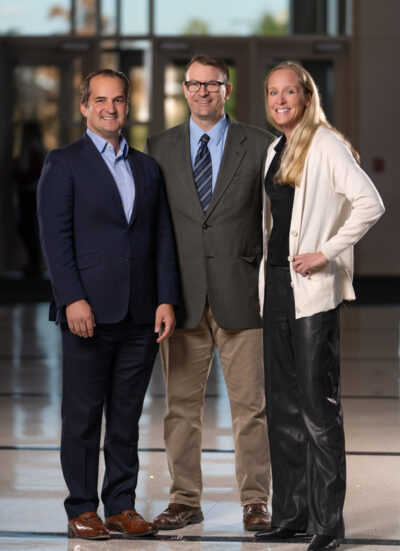
Left to right: David Zopf, MD, MS, Tony Kille, MD ’01, Jessica Van Beek-King, MD
As a key part of the team with Zopf and Kille, Jessica Van Beek-King, MD, associate professor, Department of Otolaryngology–Head and Neck Surgery, brings a broad skill set and deep compassion to her work. From cochlear implants to airway reconstruction, she treats a wide range of conditions and is passionate about education and mentorship.
Lin says the department helps train about 60 SMPH medical students per year, and those who are interested in going into otolaryngology can spend a month gaining experience.
“Our medical students say they can tell our faculty members, residents, and fellows are truly dedicated to education in clinical medicine as well as research,” says Lin.
Van Beek-King adds, “I have medical students or residents with me almost every day. I believe in letting them do as much as they can safely do, with supervision and support. That is how I learned, and I promised myself I would do the same for the next generation.”
Noting that she is especially excited about advances in minimally invasive airway surgery, such as using coblation to open collapsed cartilage rings, Van Beek-King says, “We were able to avoid a major open surgery and avoid a stay in the intensive care unit for one of our patients. That kind of innovation changes lives.”
This type of care takes a team, and that team includes the family. We are all in this together.
Jessica Van Beek-King, MD
Van Beek-King also collaborates across specialties for complex cases like vascular anomalies and congenital neck masses, working with teams from plastic surgery, hematology/oncology, dermatology, and genetics.
“This type of care takes a team, and that team includes the family. We are all in this together,” she says.
Calling Van Beek-King “a strong patient advocate who always strives to ensure the clinical offerings are efficient and impactful,” Lin says, “We know patients are waiting a long time to get into our clinics because we do not have enough doctors for everyone who needs our care. Dr. Van Beek‑King always thinks about how we can provide impactful care in our current situation.”
As the department grows, the pediatric team hopes to expand in size and scope.
“We already provide world-class care,” says Kille, “but there is room to develop more organized, multidisciplinary programs for complex sleep apnea, airway issues, and hearing loss.”
Zopf, who also leads a medical device innovation laboratory, sees the department’s new status as a springboard for even greater impact.
“It gives us the infrastructure and visibility to secure funding and scale our innovations,” he explains.
As advances in the field progress, the pediatric ENT team is united in a shared commitment to providing compassionate, family-centered care within a complex array of medical, social, and human factors. And as the Department of Otolaryngology–Head and Neck Surgery enters this new chapter, its Pediatric Otolaryngology Division is not just treating children, it is transforming lives, one breath at a time.
Lin’s Pride in the 28th Department
by Kris Whitman
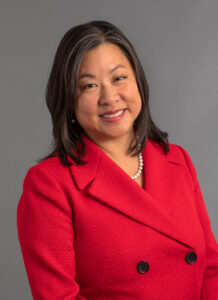
Sandra Lin, MD
“This is a monumental moment in our history, and I want to … reflect on how far we’ve come and express my gratitude for everyone who has played a role in making this achievement possible.” Those words, from Sandra Lin, MD, praised the faculty and staff of the new Department of Otolaryngology–Head and Neck Surgery on July 1, 2025 — the day it evolved from being a division in the Department of Surgery at the University of Wisconsin School of Medicine and Public Health (SMPH).
As chair of the new department and the Charles N. Ford Professor, as well as the former division chief, Lin says the faculty and staff have excelled since the 1930s in research, education, and clinical care, establishing the foundation for becoming a stand-alone department. She credits Rebecca Minter, MD, MBA, chair, Department of Surgery, Robert N. Golden, MD, emeritus dean, SMPH, and Nita Ahuja, MD, MBA, dean, SMPH, for their support of the new department.
We live out the Wisconsin Idea by improving lives, pushing the boundaries of scientific discovery, and training the next generation of otolaryngologists and other care providers.
Sandra Lin, MD
Lin, who grew up in Chicago, earned her medical degree from Northwestern Feinberg School of Medicine in Chicago and completed an otolaryngology residency at Medical College of Wisconsin in Milwaukee. She spent 20 years in the Maryland-based Johns Hopkins Department of Otolaryngology before she joined the SMPH faculty in 2022.
“I like building and moving forward, and there are plenty of opportunities and talent for that in this department,” says Lin. “We live out the Wisconsin Idea by improving lives, pushing the boundaries of scientific discovery, and training the next generation of otolaryngologists and other care providers. For patients with complicated conditions that others cannot treat, we provide exceptional care and give them hope.”
Noting that some parts of the country have a shortage of otolaryngologists, Lin says the Department of Otolaryngology–Head and Neck Surgery recently expanded its residency program and offers two fellowships, as well as training for speech and language pathologists.
“The department’s missions of education, patient care, and research function synergistically,” notes Lin, who has recruited additional clinician-scientists and plans to build upon the department’s already robust programs.
“Our research is well developed in everything from basic to clinical and translational investigations,” says Lin. “We are planning to diversify the areas in which we conduct research, including related to our strong voice research and further building our hearing, cancer, and pediatric otolaryngology research programs.”
The department is a regional leader in many areas, Lin notes, including multidisciplinary head and neck cancer and medical and radiation oncology. Faculty members are establishing collaborative approaches with other SMPH programs, such as thoracic surgery and interventional pulmonology, and with other UW–Madison areas, such as biomedical engineering, as well as with partners at other academic medical centers. Some experts have been developing and using innovative devices in clinical applications (see main article).
“There are so many career paths in this field, and we want our trainees to see firsthand many role models,” says Lin.
She adds, “I find joy in helping people — including our surgeons, research leaders, and trainees — elevate their success. And I am really proud to work with this incredible team!”