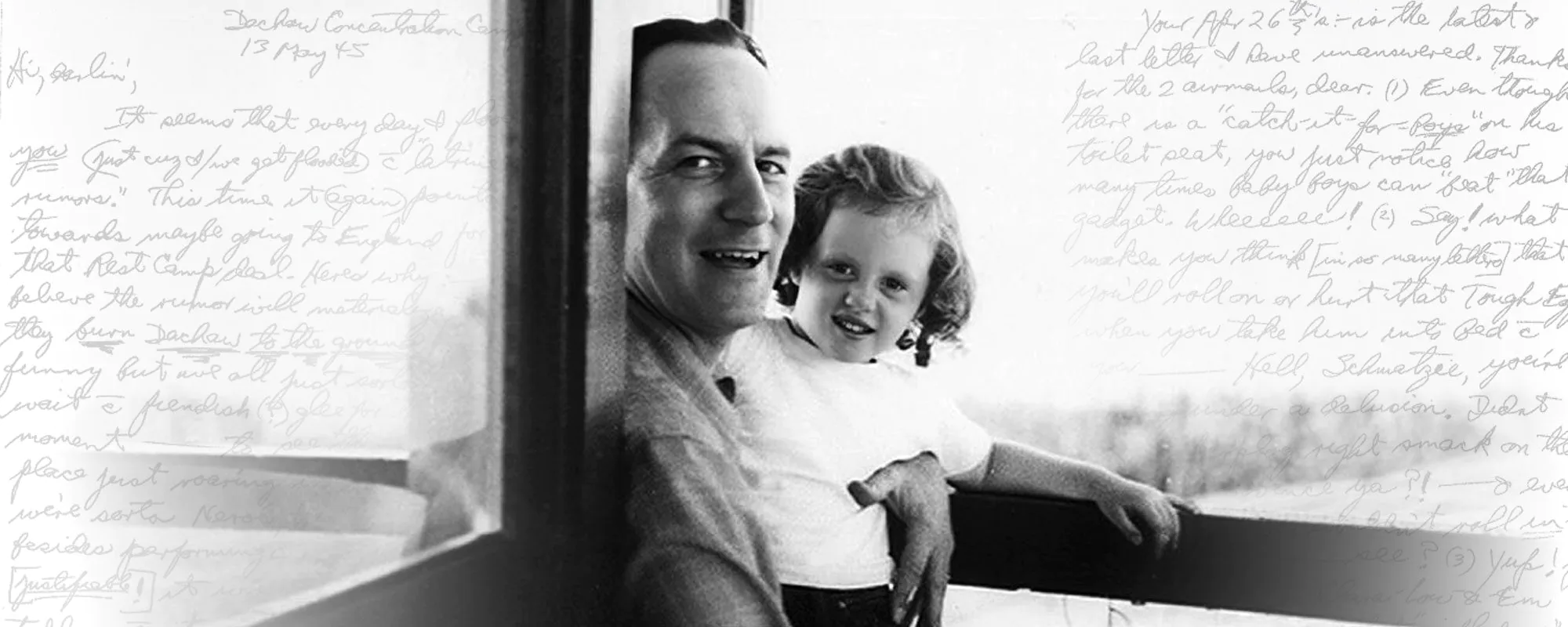
Composite image of David Wilsey, MD ’39, holding his daughter, Clarice Wilsey, with excerpts from letters written to his wife during his time in Dachau.
Share
The liberation of humans, both body and soul, is at the heart of this story. In the case of David Wilsey, MD ’39, and his family, it encompasses his involvement in World War II and the liberation of Germany’s Dachau concentration camp.
Replete with horrific atrocities and extraordinary acts of service, his experience during the emancipation of others contributed to a private, emotional asylum that neither he nor his wife, Emily Wilsey, ever shared with their children. The second liberation came when their adult children discovered evidence of their father’s extraordinary legacy.
From fall 1944 to spring 1945, David Wilsey was on the front lines with the 116th Evacuation Hospital in one of General Patton’s U.S. Army battalions. He wrote to his wife throughout his military service, including intense correspondence from post-liberation Dachau.
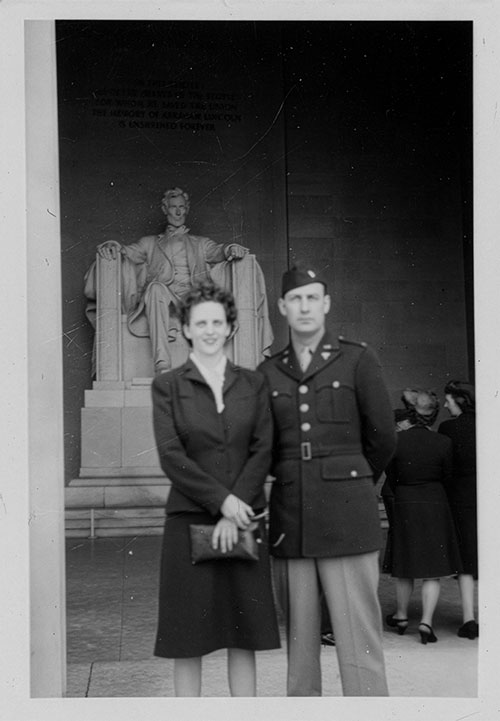
Emily Wilsey and David Wilsey, MD ’39
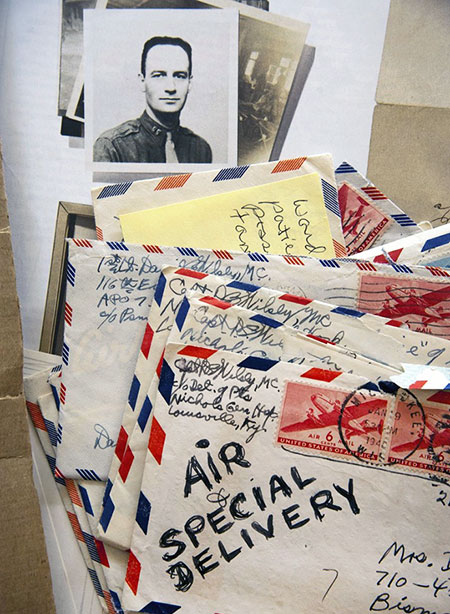
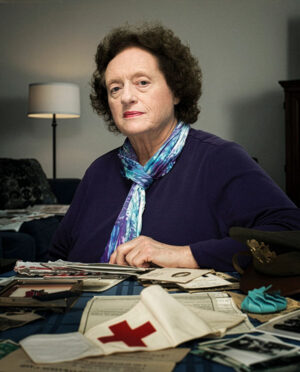
A box of his letters survived intact through residential moves and a house fire. When Clarice Wilsey and her siblings discovered the box in 2009, after their parents had died, it revealed an unknown story about their father. They also found a box of wartime photographs which six-year-old Clarice Wilsey had seen decades earlier but had been dissuaded from asking questions about. She first learned of her father’s involvement in WWII and his heroic efforts in Dachau through the contents of those boxes decades later.
By the time David Wilsey — from Oconomowoc, Wisconsin — was 20 years old, he had already lost both of his parents. He met his future wife when they were attending the University of Wisconsin–Madison. As a medical student at the UW School of Medicine and Public Health, David Wilsey was inducted into Alpha Omega Alpha. In 1939, he earned his medical degree, and the following year, she earned her bachelor’s degree in physical therapy. They shared a devout Episcopalian faith, love of sports, and desire to heal others. Habitual letter writing began when they moved in different directions to continue their studies.
The United States entered WWII in 1941, following the bombing of Pearl Harbor. Germany then declared war on the United States. Although medical professionals were exempt from the military draft, they were desperately needed. David and Emily Wilsey decided he should volunteer for service. They were married in 1943, and he enlisted on February 29, 1944. The couple’s son, Terry Wilsey, was born in August 1944. After a short leave to be with his newborn son and an intensive three-month training to care for war casualties, David Wilsey was deployed to Europe as part of the U.S. Army Medical Corps in November 1944; he was assigned to the 116th Evacuation Hospital.
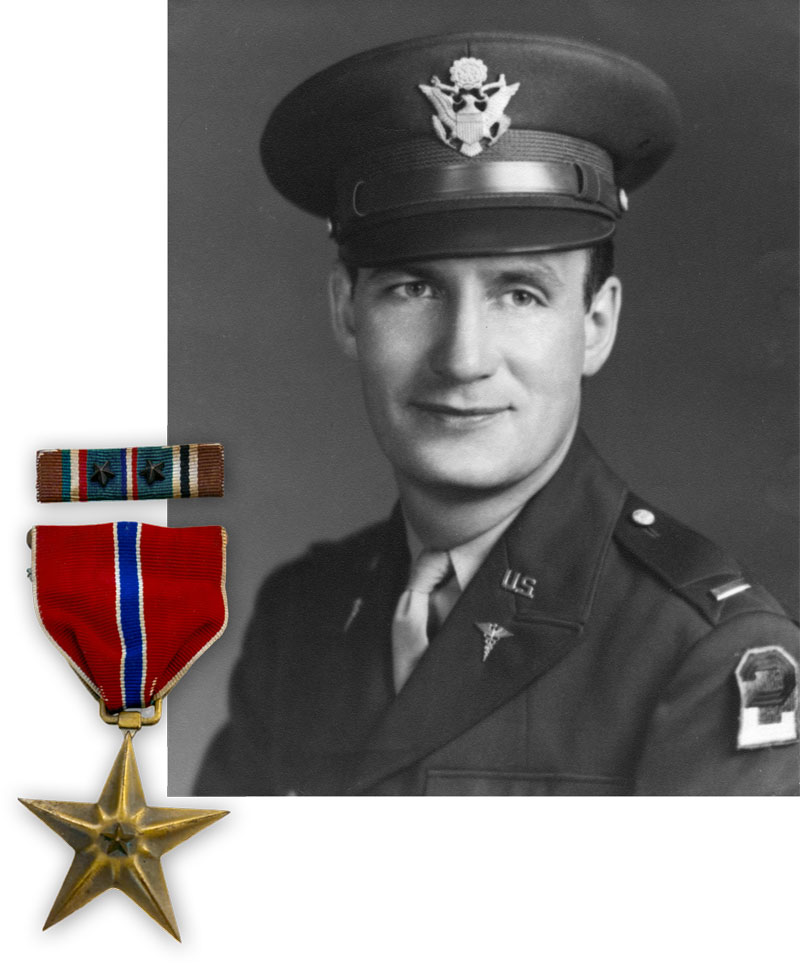
Captain David Wilsey, MD ’39,
and his Bronze Star
Given only a small window in which to acclimate, David Wilsey and others in the 116th Evacuation Hospital soon faced a constant surge of patients from what came to be called the Battle of the Bulge. This concentrated offensive from Germany, from December 1944 to January 1945, would ultimately be the American military’s bloodiest WWII battle.
David Wilsey performed anesthesia and helped complete surgeries on countless soldiers. Correspondence indicates that he often stood in the middle of multiple patients, with their bodies laid on gurneys in a pattern resembling the spokes of a wagon wheel, as he attended to them in the round — with each soldier receiving the anesthetic and surgical care they needed, one after the other. David Wilsey’s acumen in the field earned him a Bronze Star.
The Battle of the Bulge ended in January 1945, and Allied Forces were soon back on the offensive. David Wilsey was constantly on the move as his hospital unit followed the front lines while the Allies raced into Germany. For the next few months, he complained to his wife that his incoming mail was slow to arrive after being re-routed.
David Wilsey began heading his letters with the phrase “Somewhere in Germany” or “Somewhere else in Germany” to protect his hospital’s location in case the letters were intercepted. Clarice Wilsey imagines the palpable significance that letters from home had for soldiers and medical personnel. Their blue and red Air Mail envelopes, arriving in a backdrop of trauma and impermanence, must have been transcendent, she says.
Dachau was one of 44,000 concentration camps in Germany. Between 1933 and 1945, the camps contributed to the mass murder of 6 million Jewish people and tens of thousands of other targeted groups: those with disabilities, people of color, and members of the clergy. On April 29, 1945, David Wilsey aided in the liberation of the Dachau concentration camp. Alongside the rest of the U.S. Seventh Army, he found the gruesome evidence of the Nazi genocide, including piles of emaciated corpses. He and fellow practitioners — totaling just 27 at first, with additional doctors sent quickly, according to Clarice Wilsey’s research — treated countless prisoners who had survived the camp, many still succumbing to typhus, tuberculosis, or starvation.
On May 8, 1945, David Wilsey wrote to his wife about the recently liberated camp: “Emily, we are sweating, stinking, ‘existing’ in The-Hell-On-Earth-DACHAU! … Dearest, the atrocity reports are true — and more! For over 8 days I’ve seen-lived-smelled-‘existed’ it as one of 78 doctors to try to correct the medical-horror-component of The‑Hell‑On‑Earth.”
David Wilsey’s letters occasionally described moments of renewal, telling of a wedding between a nurse and doctor at Dachau, a holiday tree festooned with surplus paraphernalia, and the act of unwrapping a gift from home but then rewrapping it to pass along to someone who had not received a package. These were touchstones of humanity in a landscape of often unimaginable grief.
In one letter, David Wilsey urged his wife to “tell thousands so that millions will know what Dachau is and never forget the name of Dachau.”
Because neither David nor Emily Wilsey could bring themselves to tell the world or their children of the horrors their father had witnessed, Clarice Wilsey “decided to take on his request when I found the letters buried in the attic and my parents could not talk about his experience.”
She adds, “I feel called to be his voice.”
Tens of thousands of health care professionals have served during military campaigns. One hears, anecdotally, that the families of those physicians, nurses, ambulance drivers, and others rarely or never hear about the horrors of wartime triage and care. The practitioners often take their memories to the grave.
Such was the case for David Wilsey, who — after his military service — devoted more than 40 years practicing anesthesia in Spokane, Washington.
In 2006, Clarice Wilsey visited the U.S. Holocaust Memorial Museum in Washington, D.C., where she — by chance — recognized her father in a film. Three years later, she and her siblings found the letters and photos in a trunk, in the back of the attic, providing testimony of their father’s wartime experiences.
This discovery led to a cascade of emotions and insights that changed the way Clarice Wilsey viewed her father, her upbringing, the world, and her own calling.
Clarice Wilsey
Today, she appreciates the letters as a cautionary tale. David Wilsey wanted the realities of the Holocaust, imprisonment, totalitarianism, war, and annihilation to never be forgotten, to be a reminder that humans are capable of great harm. But he was never able to describe this to his children or the public, leaving Clarice Wilsey with the mission to do so.
Clarice Wilsey and her siblings worked with archivists at the University of Washington to digitize David Wilsey’s letters and photographs. Unfortunately, Emily Wilsey’s letters to her husband did not survive his time in the military.
The family donated David Wilsey’s original letters and photographs to the Holocaust Center for Humanity in Seattle, Washington, which houses “The Wilsey Collection.”
Further, with Bob Welch, Clarice Wilsey co-authored a book, Letters from Dachau, in 2020. She also speaks, for free, to any interested group — she welcomes invitations (lettersfromdachau@gmail.com).
In one of her presentations about her beloved father, Clarice Wilsey stated, “There are five components to this story: mystery, surprise, secrecy, atrocities, and hope.”
She says her hope is to help those who carry similar foundational stories. Those stories of resilience and trauma may have value for another generation that may also wrestle with a world compromised by individuals who are capable of malice and destruction.
Above all, she and others thank David Wilsey for his service and hope he rests in peace.
This article was based on an interview and background materials provided by Clarice Wilsey.