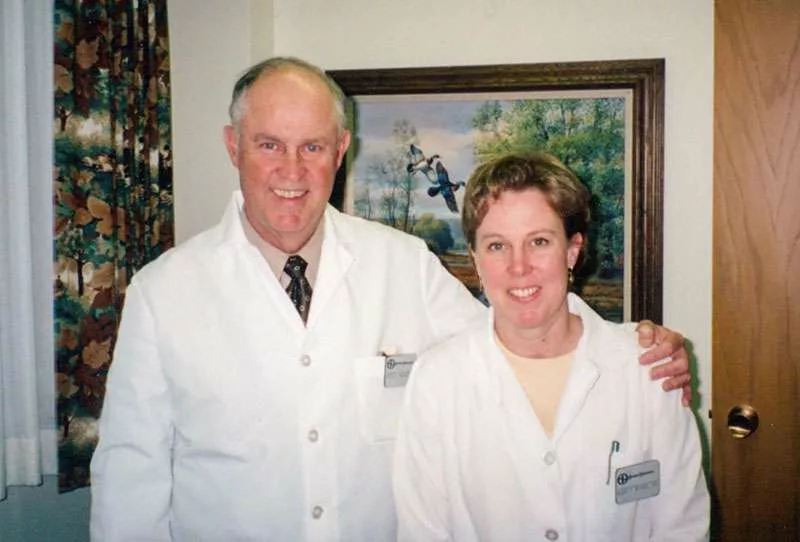
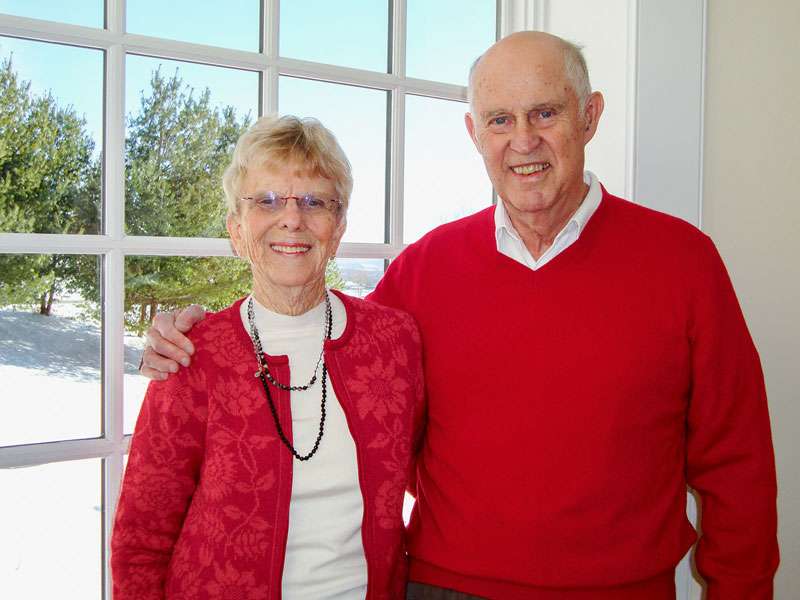
In La Crosse, Mary Morris and her husband, Jim Killoran, raised three daughters next door to her parents, and she pursued her research interests related to the therapy. Mary Morris says carrying on her father’s undertaking is bittersweet. Like her father, she finds reward in the appreciative patients who benefit from the treatment. Marveling at her father’s fortitude, she equally admires her mother, who buttressed her husband when people dismissed his theory. Mary Morris recalls, “I used to ask my dad, ‘How did you get so brave? How could you be shunned and still stand up?” She promptly responds — in a low-pitched voice to mimic her father’s likely reply, “Patients are getting better, honey! That’s what matters.”
In recent years, Douglas DeBoer, DVM, professor of dermatology at the UW School of Veterinary Medicine, working in partnership with Mary Morris, found sublingual immunotherapy effective in combating allergic reactions in dogs. It is now the standard of care in the veterinary world, Mary Morris says, noting the drops allow pet owners to administer the treatment at home and save a significant amount of money.
Establishing the Institute for Respiratory Research
Representing another legacy of David Morris’ passion — built through a sizable gift he and Sacia Morris made to his medical school alma mater, the UW School of Medicine and Public Health, in 2000 — the school established the Morris Institute for Respiratory Research in the Clinical Science Center. Designed to facilitate interdisciplinary research, the 10,000-square-foot facility brings together basic scientists and clinical experts in allergy, immunology, pulmonary medicine and more.
“My dad knew that people walking past one another in the hall to get a cup of coffee would be more likely to strike up conversations and share information for a larger cause,” Mary Morris says, as she describes David Morris’ vision for the institute. “That was, perhaps, his biggest legacy. By creating a vision for a physical space, he influenced interactions among clinicians, academicians and researchers.”
A Quarterly article in fall 2000 noted that David Morris considered the SMPH (then UW Medical School) a member of his extended family. It also noted that David Morris saw the gift as a way to further immunotherapy research and honor the memory of one of his former mentors, the legendary Dean William S. Middleton, MD. Morris was the president of the last class Middleton saw through all four years of medical school, and he remembered Middleton fondly as an involved, hands-on administrator.